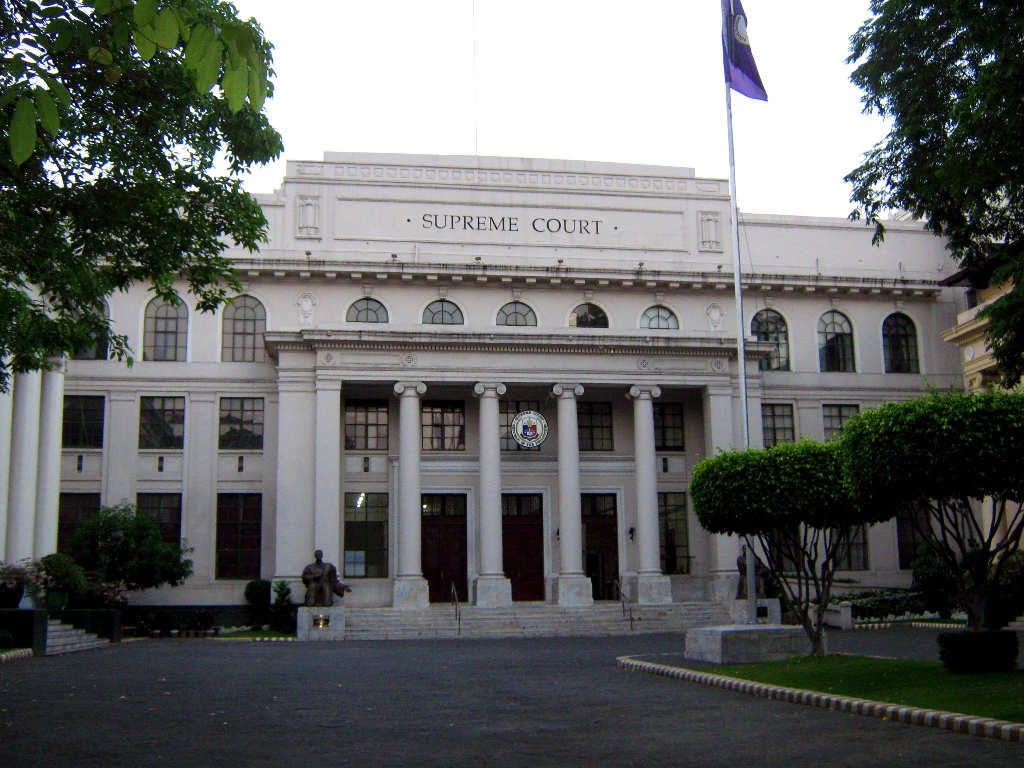
Friday, 12 July 2013

HOUSE WON'T RECOGNIZE SC JUSTICE SON - GONZALES


MANILA, Philippines - The Marinduque election controversy is far from over even with the insistence of the Commission on Elections (Comelec) that the proclaimed winner, Regina Ongsiako Reyes, was a disqualified candidate.
The House of Representatives will not recognize Lord Allan Jay Velasco, who Reyes beat and who the Comelec wants to belatedly proclaim as the new winner.
Velasco is the son of Supreme Court (SC) Justice Presbitero Velasco Jr.
“As far as the House is concerned, the duly elected representative of the lone district of Marinduque is Regina Reyes,” Majority Leader Neptali Gonzales II said yesterday.
“She was the one who has been proclaimed by the provincial board of canvassers, and she has taken her oath before Speaker (Feliciano) Belmonte and has assumed office,” he said.
On Reyes’ part, she said she would raise her disqualification in the appeal she would file with the SC asking the tribunal to reconsider its ruling last June 25 that the Comelec still had jurisdiction over the issue.

Gonzales said the Comelec lost its jurisdiction over Reyes’ case the moment the provincial canvassing board proclaimed her winner, and any question after that about her election and qualification should be resolved by the House of Representatives Electoral Tribunal (HRET).
“We have to be consistent with the Constitution, which says that the HRET shall be the ‘sole judge’ of all questions about the ‘election, returns and qualification’ of a House member. We also have to be consistent with our assertion that the HRET’s jurisdiction begins with the proclamation of a congressional winner,” he said.
In line with this stand of the House, Gonzales said the chamber is also recognizing Angelina Tan as the winning candidate in the fourth district of Quezon.
Reyes belongs to the ruling Liberal Party (LP), to which Belmonte and Gonzales also belong, while Tan is a Nationalist People’s Coalition member.
The Comelec has annulled the proclamation of both Reyes and Tan. In Tan’s case, the Comelec wanted her opponent, Wigberto Tañada Jr., who she beat by more than 4,000 votes, as the winning candidate. The Tañadas are LP members.
Gonzales said Velasco should now pursue the election protest he has filed against Reyes shortly after the latter was proclaimed winner.
“He should pursue that in the HRET, which is the proper forum and whose jurisdiction over his case he has already recognized,” he said.
Like Velasco, Tañada has filed an election protest against Tan with the HRET.
Velasco wielded influence?
In a press briefing the other day, Reyes hinted that Associate Justice Velasco allegedly wielded his influence in the tribunal’s recent decision annulling her proclamation.
But Velasco yesterday denied Reyes’ insinuation that he used his influence in the disqualification case against her. 
“The allegation that he wielded his influence in the case is baseless and malicious. Being a lawyer and an officer of the court, Atty. Reyes should have been circumspect in her statements,” Velasco’s office said in a statement.
Reyes said she is convinced that the SC allegedly sped up the resolution of her case since it failed to ask the comments of those involved in the case before issuing a ruling.
She also alleged that she was not given fair treatment by the Comelec and the SC because she was not given a chance to prove that she is indeed a Filipino citizen.
Reyes presented to the media proof that she is a natural-born Filipino, and that she was able to comply with the requirements under Republic Act 9225 in renouncing his foreign citizenship, which she acquired when she married an American citizen in the United States.
Reyes also lamented that the Comelec and SC supposedly gave credence to a published article of an unknown blogger who claimed that she is an American citizen, when the truth is, she was born in the Philippines, her parents are both Filipinos, and she also has an affidavit of renunciation of foreign citizenship.  – With Edu Punay, Paolo Romero

Para sa buong balita basahin dito


Kumento ni Fr. Joaquin Bernas Ukol Sa Kaso Ni REYES at VELASCO!


Reyes vs Velasco. No, that is not the title of the Supreme Court decision, but it could have been. The contenders for a congressional seat in Marinduque were Regina Reyes and Lord Allan Velasco.
I am not claiming that the decision of the Court against Reyes was wrong. All I want to say is that the decision missed an opportunity for the Court to teach lawyers clearer lessons on some contentious issues in election law. This might yet happen in the future. But for now let me take up four points which need elaboration.

First, how does a Filipino woman lose and later reacquire citizenship? Our Constitution says, “Citizens of the Philippines who marry aliens shall retain their citizenship, unless by their act or omission, they are deemed, under the law, to have renounced it.” But what acts or omissions may be deemed renunciation of citizenship?

Second, what is the final word on the meaning in political law of the domicile of a married woman? I recall the case of Marcos-Romualdez vs Comelec. The Court said: “Without as much belaboring the point, the term residence may mean one thing in civil law (or under the Civil Code) and quite another thing in political law. What stands clear is that insofar as the Civil Code is concerned—affecting the rights and obligations of husband and wife—the term residence should only be interpreted to mean ‘actual residence.’ The inescapable conclusion derived from this unambiguous civil law delineation, therefore, is that when the petitioner married the former president in 1954, she kept her domicile of origin and merely gained a new home, not a domicilium necessarium.” Justice Flerida Ruth Romero approached the subject as an aspect of the struggle of women for equality with men.

Third, there remain blurred issues arising from Republic Act No. 9225, the Dual Citizenship Law, in relation to election law. Section 5(2) says: “Those seeking elective public office in the Philippines shall meet the qualification for holding such public office as required by the Constitution and existing laws and, at the time of the filing of the certificate of candidacy, make a personal and sworn renunciation of any and all foreign citizenship before any public officer authorized to administer an oath.”

Does this requirement of renunciation of foreign citizenship apply to those filing a certificate of candidacy for a national office? If it does, it would seem to me to be an unconstitutional addition to the requirements for national office.

Finally, when is jurisdiction over contests passed on to the electoral tribunal? Jurisprudence has repeatedly said: “The Court has invariably held that once a winning candidate has been proclaimed, taken his oath, and assumed office as a Member of the House of Representatives, the COMELEC’s jurisdiction over election contests relating to his election, returns and qualifications ends, and the HRET’s own jurisdiction begins.” Or, stated in another manner, where the candidate has already been proclaimed winner in the congressional elections, the remedy of the petitioner is to file an electoral protest with the House of Representatives Electoral Tribunal (HRET).

In all these past cases, the HRET had already been formed. Hence, the Court could say to the petitioner, “Go to the electoral tribunal as the ‘sole’ judge of all contests.” My question now is about media reports that the losing party in this case, as of last week, has already assumed office in Congress. Is this a rebuff of the Supreme Court decision of last June 25? What will happen next?

Para sa buong kwento basahin dito

Brillantes: Walang Batayan ang Ebidensya, Brion: Minadali ang kaso!


Noong nakaraang Hunyo 5, 2013 naglabas ng “Dissenting Opinion” si COMELEC Chairman Sixto S. Brillantes Jr, ukol sa kasong diskwalipikasyong na isinampa ni Jospeh Soccoro Tan na ngayon ay kinahaharap ng nanalong Kongresista sa nag-iisang distrito sa lalawigan ng Marinduque na si Congresswoman – Elect Regina O. Reyes.
 

Ayon sa kanya, hindi sapat ang mga dokumento at ebidensyang iprinisinta ni Tan upang patunayan na si Congresswoman Reyes ay isang “American Citizen.” Ang mga “travel records” na kanyang isinumite ay walang saysay, kahit ang “printed article” mula sa panulat ni Eli Obligacion sa kanyang blog ay binase lamang sa mga sabi-sabi at walang naging batayan. Dinagdag pa niya na ang dokumentong sinasabing nangaling sa Bureau of Immigration Certification ay isa lamang “Xerox copy” at hindi pwedeng gamiting ebidensya sa Korte.

Iginiit din niya na ang isyu ng “residence and citizenship” ay kinakailangan ng masusuing pag-aaral ng mga ebidensya at ang mga ganitong isyu at dapat pinaguusapan sa isang “full – blown quo warranto proceeding” at hindi sa isa lamang “summary proceeding”.

Inakusahan naman ang ni Justice Arturo Brion sa kanyang “Dissenting Opinion” ang kanyang mga kasamahang hukom sa Supreme Court na masyadong minadali at hindi pinag-aralan ng mabuti ang kaso bago maglabas ng isang desisyon na ibasura ng petisyong pinasa ni Congresswoman Reyes. Kinuwesyon din niya ang mayorya ng hukom kung ano ang kanilang naging batayan upang magkaroon ng agarang desisyon na hindi hinihingi ang komento ng COMELEC ukol sa dito.

Ayon pa sa kanya, “Maliban kung ang isang kaso ay malinaw at maliwanag na nagpapakita na walang naging basehan at dahil lamang sa delikadesa, nararapat lamang sigurong pakinggan ng magkabilang panig bago gumawa ng desisyon na papabor sa anak na miyembro ng hukuman”

Ayon naman sa abugado ng Kongresista, nagsumite na sila ng mga dokumento at ebidensya na pinabubulaanan ang mga akusasyon sa kanya. Ilan sa mga ito ay ang Affidavit of Renunciation of Foreign Citizenship na nagpapatunay na tinalikuran na niya ang kanyang pagiging “dual-citizen” noong ika – 21 ng Setyembre taong 2012 at ang Identification Certificate na galing sa Bureau of Immigration na kinikilala ang kanyang pagka “Filipino Citizen ngunit hindi ito binigyang pansin at kinilala ng Korte.  


Tuesday, 9 July 2013

Comelec Junks Poll Case Vs Marinduque Lawmaker


By Jess Diaz (The Philippine Star) Updated July 09, 2013 - 12:00am

MANILA, Philippines - A former congressman and son of a Supreme Court (SC) justice lost his plea with the Commission on Elections (Comelec) seeking for the annulment of the proclamation of his opponent in the congressional race in Marinduque.

The Comelec’s First Division junked the petition filed by former congressman Lord Allan Jay Velasco, son of Justice Presbitero Velasco, against elected Marinduque Rep. Regina Reyes.
Two division members, Commissioners Christian Robert Lim and Al Parreño, overruled their chairman, Commissioner Lucenito Tagle, who was in favor of the cancellation of Reyes’ proclamation.
Velasco filed the petition after the Comelec disqualified Reyes for allegedly failing to renounce her American citizenship, which the congresswoman denied. The SC later upheld her disqualification.
Lim and Parreño, the newest members of the poll body, held in separate opinions that since the new Marinduque representative has already been proclaimed, has taken her oath before Speaker Feliciano Belmonte Jr. and has assumed office, the House of Representatives Electoral Tribunal (HRET) has acquired jurisdiction over her case.
They invoked a provision in the Constitution, which mandates that the electoral tribunals of the Senate and the House “shall be the sole judge of all contests relating to the election, returns, and qualifications of their respective members.”
Parreño disagreed with Tagle that for the Comelec to lose jurisdiction over a lawmaker’s case, the legislator must have been proclaimed, must have taken his oath and must have assumed office or started his term.
However, he said in several cases cited by his division chairman, the SC “did not expressly state that these three conditions must concur before the Comelec is divested of jurisdiction.”
He said in the case of Camarines Norte’s Liwayway Vinzons-Chato and Renato Unico, the high court ruled that the Comelec “has already lost jurisdiction over Chato’s petition because respondent Unico has already been proclaimed and taken his oath of office as a member of the House of Representatives.”
He said though some rulings were contradictory, the predominant opinion was that “proclamation alone is enough to divest the commission (Comelec) of its jurisdiction” on elected lawmaker’s cases.
He also held that the provincial board of canvassers did not abuse its discretion in proclaiming Reyes.
Meanwhile, the SC decision dismissing the petition filed by Reyes to nullify the disqualification ruling against her has been met with dissensions from several magistrates.
Last month, the SC voted 7-4 to dismiss Reyes’ petition questioning a Comelec ruling that cancelled her certificate of candidacy. 
Chief Justice Maria Lourdes Sereno and Associate Justices Teresita Leonardo-de Castro, Mariano del Castillo, Lucas Bersamin, Roberto Abad, Jose Perez and Bienvenido Reyes agreed with the Comelec findings and junked Reyes’ petition for lack of merit.              
Senior Associate Justice Antonio Carpio and Associate Justice Arturo Brion, Mario Victor Leonen and Martin Villarama Jr. dissented, saying the petition must not be junked instantly as the SC should first seek the Comelec’s comment before ruling on the case.           – With Paolo Romero

Dito mababasa

Saturday, 6 July 2013

SC rebuked for ruling that favored Justice's Son.


By Jerome Aning
Philippine Daily Inquirer
5:31pm - Saturday, July 6th 2013


MANILA, Philippines—A Supreme Court justice has handed a stinging rebuke to colleagues who voted to dismiss outright a petition by Marinduque
Representative Regina Ongsiako-Reyes to stop the Commission on Elections from disqualifying her for being allegedly a US citizen, in a ruling that favored the son of one of the court’s justices.

Associate Justice Arturo Brion
In his 21-page dissenting opinion, Justice Arturo Brion accused the majority of a “rush to judgment” and criticized the June 18 majority ruling for being arrived at without seeking comment from the Comelec, for failing to rule on the merits of the case, and for encroaching on the jurisdiction of the House of Representatives Electoral Tribunal.

“I submit this dissenting opinion to express my strong reservations to the majority’s outright dismissal of this most ‘unusual’ case—a term I do not use lightly,” Brion said in his dissent, which was posted on the Supreme Court’s website.


Brion’s dissent was supported by Justices Antonio Carpio, Martin Villarama and Marvic Leonen.

According to Brion, the questions raised in Reyes’ petition were “not too unsubstantial to warrant further proceedings,” as the majority of justices ruled.

“[U]nless the case is clearly and patently shown to be without basis and out of our sense of delicadeza (which we should have), the court should at least hear and consider both sides before making a ruling that would favor the son of a member of the court,” he said.

“If this court is indeed serious in administering justice or at least to be seen to be administering justice in the way described in the speeches of many a justice of this court, it should not deliver the kind of hasty and imprudent action that it did in this case. The proper course of action, if the court indeed honestly wants to achieve this objective in the present case, is to require the Comelec to comment on the petition and to decide matters from that point,” he added.

Brion said the outright dismissal of Reyes’ petition left the losing candidate, Lord Allan Jay Velasco of the National Unity Party, as the “indirect beneficiary” because he would then be proclaimed the real winner upon Reyes’ disqualification. Had the case reached the court via the HRET, Reyes’ disqualification, if upheld, would have left the congressional seat vacant and new elections would have to be held.

Velasco is the son of Justice Presbitero Velasco Jr., who, along with Justices Jose Mendoza and Estela Perlas-Bernabe, inhibited themselves from the case.
The majority decision, penned by Justice Jose Perez, was backed by Chief Justice Ma. Lourdes Sereno and Justices Teresita Leonardo-De Castro, Lucas Bersamin, Mariano del Castillo, Roberto Abad and Bienvenido Reyes.

Brion also said that the majority’s claim that the jurisdiction of the HRET applied only after the candidate has assumed  office on June 30 was contrary to prevailing jurisprudence.

“[I]n fact, it is  a major retrogressive jurisprudential development that can emasculate the HRET,” he said.

The Comelec en banc, on May 14, affirmed the ruling of the commission’s First Division that declared Reyes was disqualified to run for public office for holding a US passport and for failing to renounce her US citizenship, which she acquired when she married a US citizen. With her being a naturalized US citizen, Reyes was also ruled to be an illegitimate resident of Marinduque and thus disqualified from running for office.

Reyes was proclaimed winner of the congressional race by the provincial board of canvassers, technically an arm of the Comelec, on May 18.

The Comelec upheld with finality its decision to disqualify Reyes on June 5.

Reyes, a member of the ruling Liberal Party, took her oath of office before House Speaker Feliciano Belmonte on June 7, She  filed her suit at the Supreme Court on the same day, accusing the Comelec of grave abuse of discretion and stating that the HRET should already have acquired jurisdiction over the case.

On June 18, the high court, voting 7-4, issued a resolution denying Reyes’ petition. The majority said the Comelec retained jurisdiction of the case because, among others, Reyes had not yet begun serving her term as congresswoman.

Brion said that the intervening events should have made the court conduct further inquiries and exercise prudence.

“In this situation, the court cannot simply go through the motions of evaluation and then simply strike out the petitioner’s positions. Some, to be sure, may label the denial of further inquiry to lack of prudence; other’s, not so charitably minded, may however, refer to this as partisanship. I can only surmise that the majority might have considered the jurisdictional issues raised ‘too insubstantial to warrant further proceedings.’ Is this still lack of prudence?” he said.

On the issue of jurisdiction, Brion said the court should have at least asked for comment from Comelec, the Office of the Solicitor General and the HRET before dismissing Reyes’ petition outright.

Brion added that the Comelec “does not appear to have an airtight case based on substantial evidence on the citizenship and residence issues, and much less a similar case on the jurisdictional issue, to justify a very prompt outright dismissal action” from the court since Reyes still had “arguably meritorious positions” to support her cause that the court deserved to hear.


Para sa buong kwento, Basahin dito!

Wednesday, 3 July 2013

Unang Batch Ng Mga Bagong Kongresista, Nagtapos Ng Executive Course!


Photo courtesy of Pecto Camero, Media Relations Service - PRIB / 26 June 2013 04:46:59PM 
Matapos ang 3 araw ng pagpapalitan ng kanilang mga kuro-kuro at idelaismo sa epektibong paraan ng "Law-Making" sa ginanap na Executive Course sa mga bagong nailuklok na Representante ng ating lehislaturang sangay ng Pamahalaan.

Pinamunuan ito ni House Speaker Feliciano Belmonte Jr., House Secretary General Marilyn Barua - Yap, kasama ang kapita-pitagang Up Vice President for Public Affairs Dr. J. Prospero De Vera III at sa pakikipagtulungan ng University of the Philippines - National College of Public Administration and Governance (UP-NCPAG).


Kasama sa mga nagtapos ang kaisa-isang Representante ng lalawiagn ng Marinduque na si Atty. Regina "Ate Gina" Reyes na pinabilib ang mga kasamahang Kongresista dahil sa kanyang pinamalas na galing at kaalaman tungkol sa paggawa, pagmungkahi at pagpasa ng mga batas.

Kasama din sa mga nagtapos ay sina:

Rep. Rodrigo A. Abellanosa; (Cebu City)
Rep. Raneo E. Abu; (Batanagas City)
Rep. Frederick Abueg; (Palawan)
Rep. Maria Lourdes O. Acosta; (Bukidnon)
Rep. Ansaruddin A. Adiong; (Lanao Del Sur)
Rep. Magnolia Rose C. Antonino - Nadres; (Nueva Ecija)
Rep. Mirasol Aragones - Sampelo; (Laguna)
Rep. Maryann N. Arbison; (Sulu)
Rep. Enrico Aristotle Aumentado; (Bohol)
Rep. Catherine Barcelona - Reyes; (Camarines Norte)
Rep. Jose Christopher Y. Belmonte; (Quezon CIty)
Rep. Francisco A. Calalay Jr.; (Quezon City)
Rep. Cheryl Deloso - Montalla; (Zambales)
Rep. Lawrence Lemuel Fortun III; (Agusan Del Norte)
Rep. Joseller M. Guiano; (Pampanga)
Rep. Douglas S. Hagedorn; (Palawan)
Rep. Teodorico T. Haresco, Jr.; (Aklan)
Rep. Elisa T. Kho; (Masbate)
Rep. Paulino Salvador C. Leachon; (Oriental Mindoro)
Rep. Zajid G, Mangudadatu; (Maguindanao)
Rep. Damian G. Mercado; ( Southern Leyte)
Rep. Eric D. Olivarez; (Paranaque City)
Rep. Gavini C. Pancho; (Bulacan)
Rep. Mary Ann Pernes; (Siquijor)
Rep. Aileen C. Radaza; (Lapu-Lapu City)
Rep. Maria Leonor G. Robredo; (Camarines Sur)
Rep. Estrellita B. Suansing; (Nueva Ecija)
Rep. Angelina D. Tan; (Quezon)
Rep. Abraham N. Tolentino; (Cavite)
Rep. Juliette T. Uy; (Misamis Oriental)
Rep. Alfredo Paolo D. Vargas III; (Quezon City)

Tuesday, 2 July 2013

VERDE PASSAGE MARINE CORRIDOR PROTECTED ACT OF 2013


Sa pagbubukas ng unang araw ng ika-16 Kongreso, nagsama sama ang mga kongresista mula sa lalawigan ng Marinduque, Mindoro, Romblon at Batangas sa pangunguna ni Congresswoman - Elect Atty. Regina "Ate Gina" Reyes upang maghain ng isang House Bill na tinawag na “Verde Passage Marine Corridor protected Act of 2013” na naglalayong maprotektahan ang mga marine sanctuary at bio diversity center sa buong bansa.

Naghain din ang grupo ng isang House Resolution upang kalampagin ang Department of Environment and Natural Resources o DENR upang agarang maresolba ang mga naapektuhan sa problema ng MARCOPPER sa lalawigan.